Social Commerce the New Stage of eCommerce, or What?
In this article we’d like to shed some light on a fairly new phenomenon in the development of Internet commerce that’s a social commerce.
Probably you’ll say: “Maan, hold your horses, if this is about social plugins for websites, we know everything about this stuff, actually we’ve installed couple of items, they work pretty fine. Case closed."
So, I’m not going to reason you over and over again that you need to install social buttons onto your website and blah blah blah. I’ll try to uncover the issue of social commerce and the consequences of changing patterns of consumer behavior, and the entire change of eCommerce strategy, when the priority is to develop relationships with the consumer, but not about advertise and engage them.
To start let’s see what social commerce is. It's a subdivision of electronic commerce that uses social media to consult users in purchases of products or services, to give recommendations based on their interests mentioned in social profiles, and to encourage users to interact with friends, using the elements of the promoted product (Likes, Shares, Invitations, Social Apps, etc.) Examples of social commerce include buyer’s ratings and reviews, user’s online recommendations, shops in social networks, apps and ads in social media, etc.
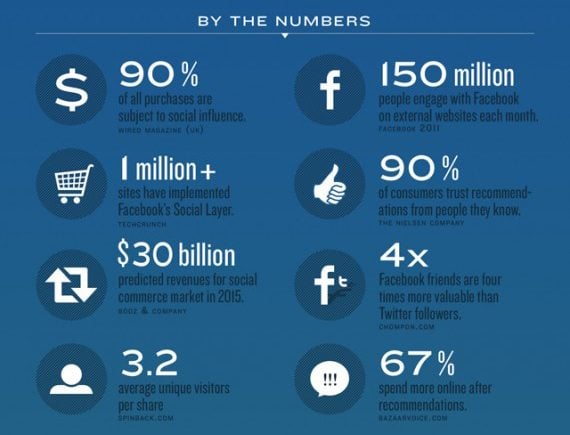 Couple years ago, using social media in development/promotion of online store was perceived in two ways:
- some used it to generate traffic, the only thing needed was the group in the network;
- others didn’t see much use in it and relied on SEO and ads.
Both were right, to some extent.
Social networks can serve as an excellent source of targeted visitors, and in some cases you can transfer your store directly to the network (as a separate app for Facebook). But in order to get these visitors you need to work a lot, and the amount of work exceeds efforts spent on SEO and advertising altogether.
How It Was?
Couple years ago everything was really easy, all you needed to do is to optimize pages, launch context ads and...that’s it, you could sit back and wait till the phone starts ringing. Today this is nothing, for a few reasons:
- competition grows (you will not get into the TOP just that way, and sometimes context ads cost may dumbfound you);
- buyers became cleverer: before they buy stuff, they read reviews and testimonials, they compare prices, consult customer support, ask friends...
... it’s not that easy to lure someone to the website, but to make someone buy is even harder. Under these circumstance, development of the social component is just the next stage of eCommerce evolution.
How It Works?
Depending on your goals, the strategy of development of your presence in social networks will be completely different. For big brands, the primary goals are:
- increase of brand awareness;
- loyalty formation;
- working with reviews;
- indirect increase of sales as the main KPI.
For small businesses, the main target is to make sales by minimal costs.
- Set metrics that will show success of the company (amount of new fans, likes, shares, comments, etc.).
- Create community.
- Publish really interesting material for your audience.
- Respond quickly to comments, the work and feedback.
- Integrate communication channels with social networks.
- Encourage information spread (provide discount for some activities, etc).
- Point out most active members of the community, and further encourage them.
- Ask customers to leave feedback about product in your community.
Why Do We Need Social Commerce?
 Have you read the old German fairy tale "Hansel and Gretel"? The boy in the story lets a trail of breadcrumbs through the forest to follow home. Today every Internet user leaves almost the same trail. If you're using Google services than you are probably receiving monthly "activity reports", there you can find each of your search requests, link to every video you watched on YouTube...the Big Brother is watching you...
Using some special tools online merchants can use this information to offer you products that you need but not heaps of something unclear...Does anyone know if such tools exist?
We're already seeing much more dynamic space for the top eCommerce sites where products change based on what you've bought before, looked at or simply on your shopping habits. I think there will be a huge move towards a more integrated approach, cross sectioning the data we leave as we browse, with our social and mobile lives to give us a highly personalised and relevant shopping experience.
***
Most guys writing about social commerce usually miss some really important things that have a negative assessment of buyers, as representatives of “human masses”. Simple example, iPhone user said that Android is garbage and all his friends will think that Android is garbage no matter what experts think about this standoff.
 Customer’s community, like any other community, may be subjected to mass hysteria. That may have both positive (all of a sudden users may behave hysterically because of some product) and negative states (they may start hating it all at once). Such situations is quite beyond the control of advertising or PR-service of vendor/manufacturer. A single personality with an excess of emotions could shut everyone up with cries of delight or anger, what’s more important this howling will be pinned down by others. But in the end even positive hysteria can be harmful - the stock of a desired product will come to end and buyers will become really frustrated.
 Online merchants tend to offer their products via social commerce, even though the product is not for massive audience. Offering such products for the mass market can be extremely difficult, for some it may seem too expensive, for others doubtful as being sold as consumer goods. Meanwhile, individual members (especially those who have an excess of time), can "spam" this product with their negative comments that will end up with hatred towards the merchant and a product.
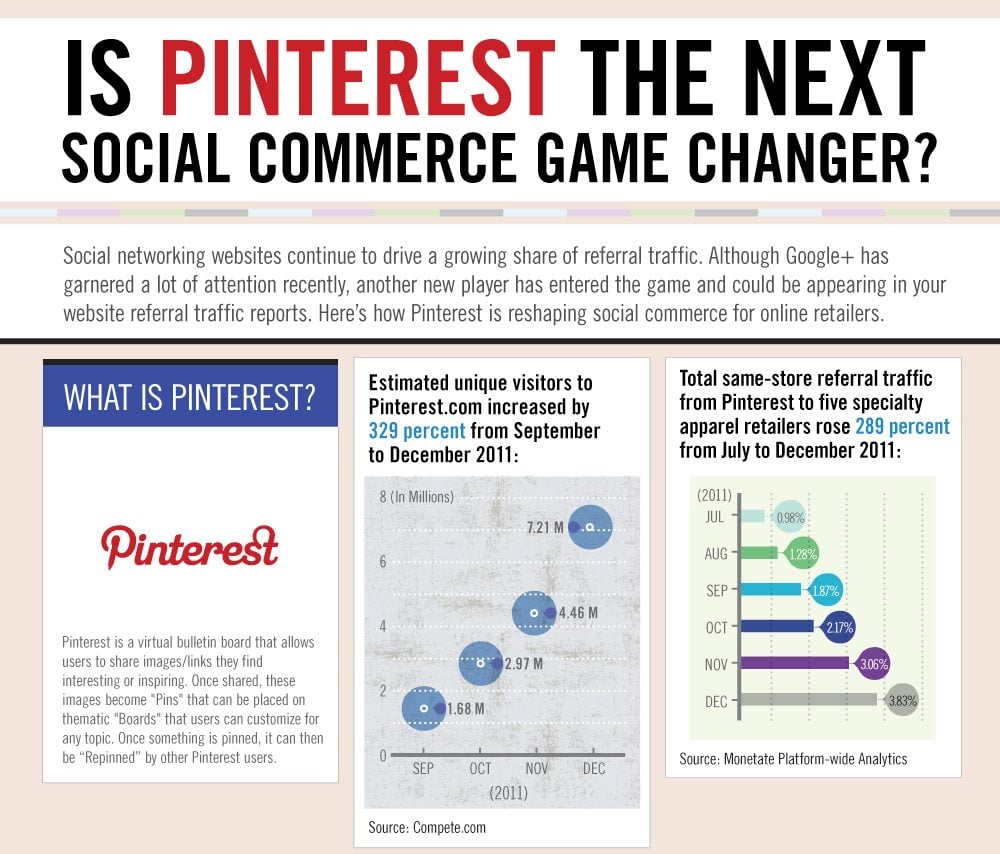
On the other hand it’s hard to define whether or not social networks are good for social commerce, the issue is absolutely in another thing - social commerce tools are not accustomed to sell products, users simply do not rely on such offers. On the other hand, if such tools will be added, the essence of social network will be lost, and social commerce will turn into traditional commerce. Today people have high hopes for pinterest as a perfect platform for social commerce. Check out the infographics below.
This is kinda strange when users' reviews are dragged out into the foreground to become an important supplementation of the product. When reviews are limited somehow and have moderators, or guest stars (whose authority is really high for whatever reason) we’ve already seen all these things in any other conventional online store.
Plus, we must not forget that not all buyers can chat about the products, some think that nobody cares about their opinion, others don’t care about writing reviews.
 Just for talks, visit any thematic forum of any kind of products (from cars to stockings), 70% of discussions are completely empty and meaningless, 25% - are Internet trolls, and the remaining 5% - are the objective of positive information from "gurus" of this or that product. Mostly, social network users are not prepared to mix their purchases with social things.
The same thing can often be seen in games. If you are an Android user than you definitely know how annoying it is when you are asked to share your game achievements. Lots of people do not want to admit that they play games, and these reports may violate their status thus humiliating them in the eyes of their surroundings. It’s not necessary for a normal person to tell that he grew a super pig on his virtual farm, especially when being on workplace.
***
Shopping has always been social activity, even before Internet and supermarkets were invented. People always shared their experience about sellers with friends - social networks simply added some muscle power to this activity. Shopping experience of your friends can either build or destroy your trust to this or that merchant, you can always rely on what others say, better try on your own. Shopping will always be social action, no matter how you get the products.
SPEAK UP!
Time to show down. Tell everyone, how often you read comments or reviews about the desired product? Do you rely on the opinion of your surroundings or you try not to "use your friends brain" and experience and do stuff on your own? Have you ever bought anything using Facebook apps but not through the stores themselves?
***
Image credits:
social commerce concept by Shutterstock
Dislike by Shutterstock
Forum by Shutterstock

Get more to your email
Subscribe to our newsletter and access exclusive content and offers available only to MonsterPost subscribers.

Leave a Reply
You must be logged in to post a comment.